August 9, 2026
Sticker Chart for Sharing: Stop Sibling Toy Fights
Struggling with toy fights between siblings? Learn how a printable sharing chart teaches taking turns and ends daily battles. Get your free chart now.
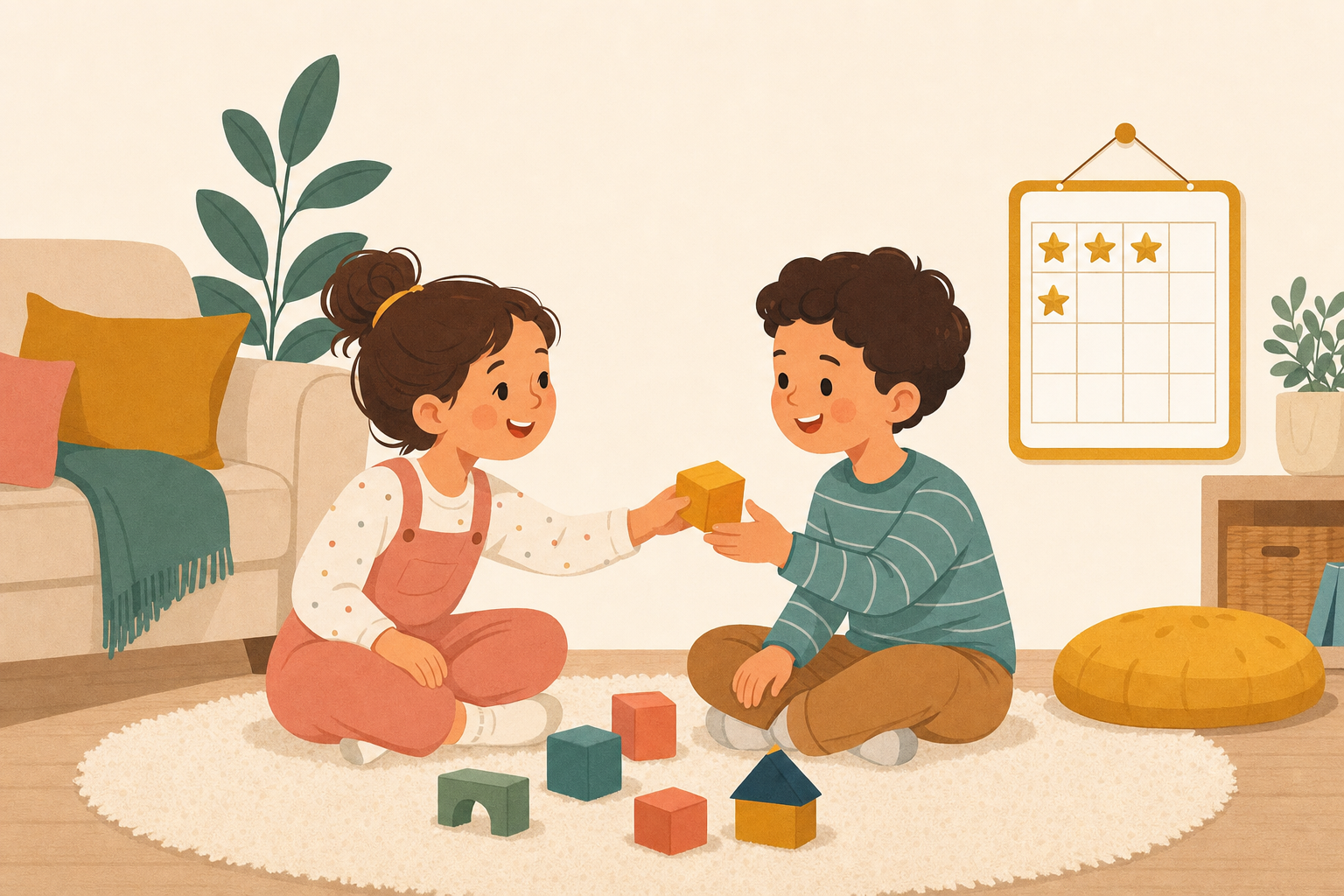
Why Sharing Charts Usually Fail (and What to Do Instead)
Your 4-year-old grabs the truck the second their sibling picks it up, and within ten seconds you're refereeing a screaming match over a toy neither of them was using an hour ago. A sticker chart can help here, but most parents set them up wrong. They put "share nicely" on the chart, which is too vague for a 3- to 6-year-old to actually do on purpose.
Kids this age aren't sharing-resistant because they're selfish. Their brains are still building the skills to wait, negotiate, and tolerate someone else touching their stuff. A sticker chart for sharing with siblings works when it rewards specific, visible actions instead of a personality trait like "being nice."
Pick the Exact Behaviors You're Tracking
Skip "sharing" as a category. It's too broad and too easy to argue about. Instead, break it into two or three concrete behaviors a preschooler can actually recognize in themselves.
Good options for a reward chart for siblings who fight over toys:
- Using a timer to take turns with a toy
- Asking "can I have a turn?" instead of grabbing
- Trading one toy for another instead of yelling
- Walking away and telling a grown-up instead of hitting or grabbing back
Pick two of these to start. More than that overwhelms both the chart and the kid. Write or draw each behavior as its own row so it becomes a visual behavior chart for sharing and taking turns rather than one fuzzy goal.
For a 3-year-old, use pictures instead of words: a drawing of two kids trading toys, a picture of a timer, a stick figure asking a question with a speech bubble. For a 5- or 6-year-old, short phrases work fine alongside a small icon.
Set Up the Chart So It Rewards the Moment, Not the Day
A sticker chart for sharing with siblings works best when the reward happens close to the good behavior, not at bedtime when the moment is long forgotten. For kids in this age range, same-day feedback matters more than a weekly total.
Here's a setup that holds up under real sibling chaos:
- One sticker per successful turn-taking moment, not per hour of good behavior. If your child uses the timer and hands over the toy without a meltdown, that's a sticker, right then.
- A visible spot near where the fighting happens. Tape the chart to the wall in the playroom or living room, not tucked in a drawer. Kids need to see it mid-conflict to remember it exists.
- A small daily reward at 3 to 5 stickers, like picking the show for family movie night or choosing dinner sides. A small win keeps momentum going without making the chart feel impossible.
- A bigger reward at the end of the week, like a trip to the park or picking a new toy from a $5 bin. This gives the chart a finish line kids can look forward to.
Both siblings should have their own chart, even if only one of them is the main instigator. Sharing is a two-person skill, and giving both kids stickers for good turn-taking keeps it from feeling like punishment for one child.
If you want a done-for-you version, Sticker Chart Maker lets you build and print one of these in a few minutes with your own target behaviors already filled in.
Scripts for the Actual Toy Fight
The chart only works if you have something to say in the ten seconds before the fight escalates. This is where most positive reinforcement charts for sharing fall apart: parents set up the chart, then forget to connect it to the moment of conflict.
Try these instead of "just share":
- Before it starts: "I see you both want the blue truck. Let's set the timer for 3 minutes each. Whoever waits calmly gets a sticker."
- Mid-grab: "Grabbing doesn't get you a turn. Asking does. Try again: 'Can I have a turn?'"
- After a good moment: "You asked instead of grabbing. That's a sticker. Go put it on your chart."
- After a bad moment: "That was a grab, not an ask. No sticker this time. You'll get another chance in a few minutes."
Keep your tone flat and matter-of-fact, not angry. The goal is to make the sticker chart do the work of tracking behavior so you're not the only enforcer standing between two kids and a toy.
Troubleshooting: When the Chart Stops Working
A printable sharing chart for preschoolers usually loses steam around day 4 or 5. A few common reasons and fixes:
The reward is too far away. If the big prize is a week out and your child is 3, shrink the timeline. Try a full chart of 5 stickers instead of 20, so it's over in a day or two at first.
One sibling is winning all the stickers. This usually means the target behavior is easier for one kid's temperament. Adjust so both kids have at least one behavior they're naturally decent at, so neither one gives up early.
The chart becomes another thing to fight over. If kids start fighting about whose sticker turn it is, put you in charge of placing stickers rather than letting them do it themselves.
The novelty wears off. Swap the sticker theme every couple of weeks, or let your child pick new stickers at the store as a small reset. If you're rotating through different chart formats, it helps to look at how other reward-chart problems get solved too. A related setup for toddlers who won't sit for potty training uses the same short-cycle, same-day reward logic that works well here.
For a deeper dive specifically on taking turns and toy battles, our companion post on stopping sibling toy fights with a sticker chart walks through a slightly different reward structure you can mix and match with this one. There's also a version focused on handling ongoing sibling fighting patterns if the conflict shows up outside of toy time too, like at the dinner table or in the car.
When the Chart Isn't Enough
Be honest with yourself if the fighting is constant, intense, or involves real aggression rather than everyday toy squabbles. A sticker chart is a tool for building a habit, not a fix for every kind of conflict. If grabbing turns into hitting regularly, or one child seems anxious around the other, that's worth talking through with your pediatrician rather than trying to sticker your way out of it.
For most everyday "I had it first" battles, though, a taking turns reward chart for kids gives both siblings a clear, fair way to earn recognition for the hard work of waiting their turn. When the week's chart is full, keep the celebration low-key and low-cost. A free coloring page from Chunky Crayon makes a nice no-cost reward that both kids can do side by side, which is a good way to practice sitting near each other without a toy to fight over.
Start small, track something specific, and give the reward close to the good moment. That's what turns a sticker chart from a fridge decoration into something that actually stops the daily toy battles.