August 5, 2026
Sticker Chart for Sibling Fighting: Stop Toy Battles Fast
Struggling with sibling toy fights? Learn how to use a sticker chart for sharing and turn-taking to end battles and build peaceful play. Try it today.
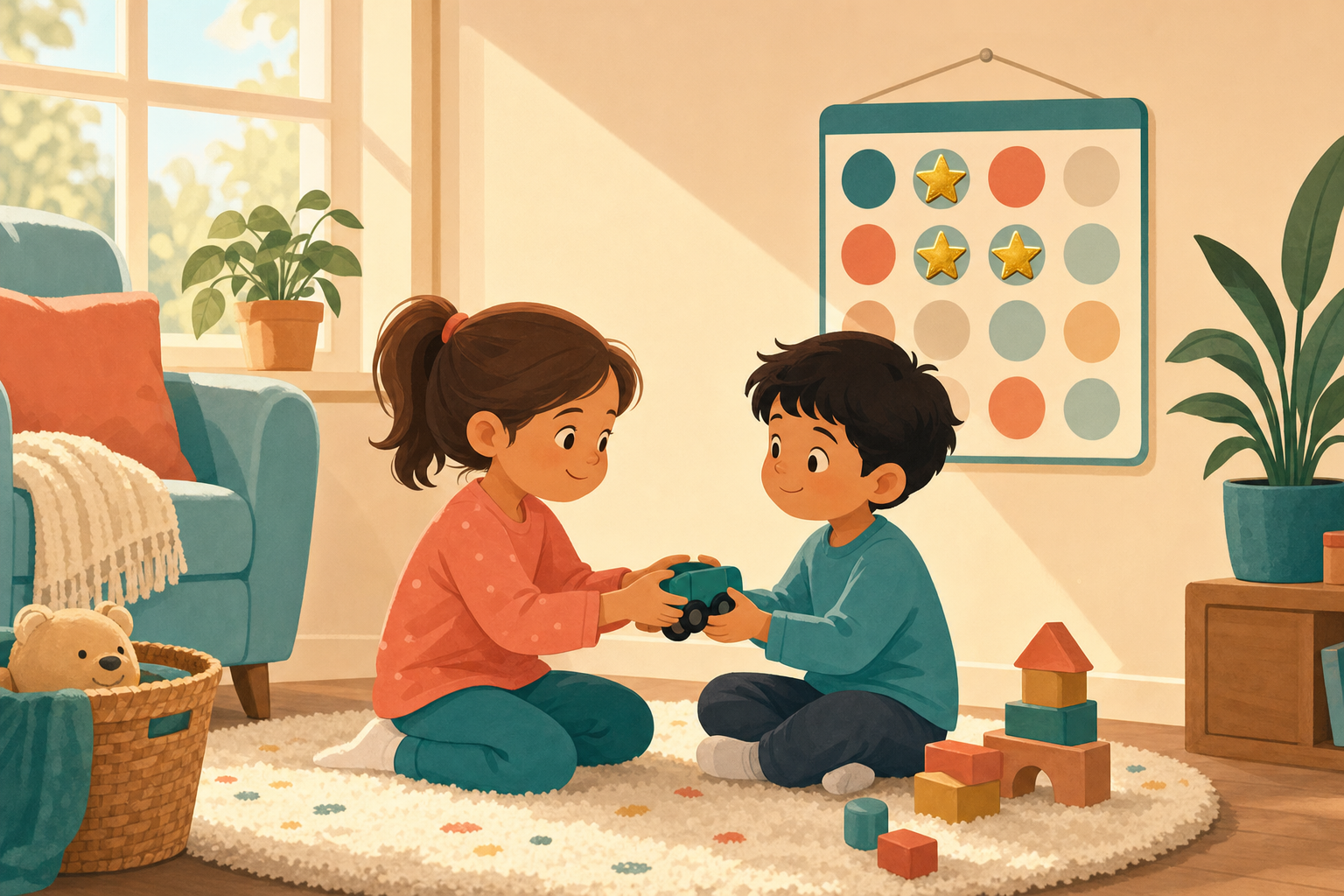
How to Use a Sticker Chart for Sibling Fighting Over Toys and Turns
Your kids fought over the same plastic dinosaur four times before breakfast, and it's not even 8am. If every disagreement between your children turns into a full battle, you're not alone, and a sticker chart can actually help, but only if you set it up the right way. Most reward charts fail at this because they're too broad ("be nice to your sister" isn't something a 4-year-old can track). Here's how to build one that targets the actual behavior you want to see.
Why Generic Behavior Charts Don't Fix Sibling Fighting
A chart that says "good behavior" or "be kind" doesn't give a 3- to 7-year-old anything concrete to aim for. Kids this age need specific, observable goals, not vague values.
The fix is picking one narrow skill at a time instead of trying to solve all sibling conflict at once. Some starting points:
- Asking for a toy instead of grabbing it
- Waiting for a turn without yelling
- Using words when upset instead of hitting or pushing
- Trading toys back after a set timer
If you're dealing with actual hitting or snatching alongside the arguing, it can help to look at a sticker chart built specifically for hitting, grabbing, and sharing issues and borrow the language from there for the physical part, while your new chart handles the turn-taking piece.
Setting Up a Sticker Chart for Sharing and Taking Turns
Start with one child if the fighting is mostly one-sided, or run identical charts for both kids side by side so it feels fair. Keep the goal small enough that they can hit it multiple times a day.
A simple version looks like this:
- Goal: "I asked for a turn instead of grabbing"
- Sticker earned: Every time it happens, even once during a rough day
- Chart length: 5 to 7 stickers to a small reward, not 30
- Reward: Something small and immediate, like picking the next family show or getting first pick of a snack
Short charts work better for this age group because kids need to see progress fast. A chart that takes three weeks to fill feels pointless to a 5-year-old who's mid-meltdown over a toy right now.
For kids around 3 to 4, track just one behavior at a time. For 6- to 7-year-olds, you can add a second row, like "gave a toy back when the timer went off," once the first habit is sticking.
What to Actually Track (Specific Examples)
Vague categories like "played nicely" don't hold up when you're exhausted and trying to referee. Use specific, catchable moments instead:
- Said "can I have a turn when you're done?" instead of grabbing
- Walked away instead of hitting when upset
- Set a timer together and respected it
- Offered to trade toys without an adult stepping in
- Used a calm voice during a disagreement, even if they didn't get their way
Write these directly on the chart in kid-friendly language, or draw a small picture next to each one if your child isn't reading yet. The more concrete the behavior, the easier it is for a young child to recognize when they've earned it, and easier for you to catch it in real time.
Scripts for the Moment It's About to Blow Up
The chart only works if you catch the good moments, not just the bad ones. Kids this age need you to narrate what you're rewarding, out loud, right when it happens.
Try these in the heat of the moment:
- "You asked for the truck instead of grabbing it. That's a sticker."
- "I saw you wait for your turn even though you really wanted it now. Nice job, that's going on your chart."
- "You're both upset, but nobody hit anybody. That's worth a sticker for each of you."
When a fight does happen anyway (and it will), skip the lecture in the moment. Separate the kids, let things cool down, and save the chart conversation for later: "Let's talk about what we could try next time so you both get a turn." The chart isn't a punishment tool. It's for catching the good moments, not tallying the bad ones.
When a Sticker Chart Isn't Enough
Be honest with yourself about what a chart can and can't fix. If the fighting is constant, physical, or seems to be about something bigger (a new sibling, a recent move, not enough one-on-one time with a parent), a sticker chart is a nice support, but it won't solve the root cause on its own.
Signs you need more than a chart:
- The fighting happens even when there's nothing to fight over
- One child seems to be seeking a reaction rather than the toy itself
- Aggression is escalating instead of leveling off after two weeks of consistent tracking
In those cases, the chart can still run in the background as a tool, but pair it with more one-on-one time with each child, or a chat with your pediatrician if hitting is frequent and intense. A chart works best as one piece of a bigger plan, not a stand-alone fix.
If your kids also struggle with independent play once the toy dispute is resolved, it might help to build in structured solo time using ideas from independent play activities for 4- to 6-year-olds, since a lot of sibling fighting happens simply because both kids want the same thing at the same time with nothing else to do. Separating their play for stretches of the day can lower the number of daily flashpoints before you even get to the chart.
Making the Reward Feel Worth It
Keep rewards small, immediate, and mostly non-material. Sticker charts lose power fast if the payoff feels far away or requires you to buy something every time.
Good low-cost reward ideas for a full chart:
- Choosing the next family movie or game
- 10 extra minutes before bedtime
- A special "first pick" privilege at snack time
- A free coloring page from Chunky Crayon as a no-cost reward when the chart is full, something both kids can enjoy side by side without another turn-taking battle
If your kids are prone to losing interest in a chart after a few days, rotate the reward, or switch the chart's design entirely every couple of weeks. A fresh look keeps a 3- to 7-year-old engaged longer than the exact same grid.
The Bottom Line
Sibling fighting over toys and turns is developmentally normal, but a well-targeted sticker chart can genuinely reduce how often it turns into a full battle. Pick one specific behavior, track it in the moment with clear language, keep the chart short, and treat it as one tool among several rather than a magic fix. Small, catchable wins add up faster than most parents expect, and a lot of the daily tension eases once kids have a clear, simple way to earn recognition for doing the hard thing instead of grabbing.