August 21, 2026
Bedtime Sticker Chart: Fix Pajama Battles for Ages 3 to 6
Struggling with pajama refusal at bedtime? Try a free bedtime reward chart printable that ends nightly battles for good. Get tips and download now.
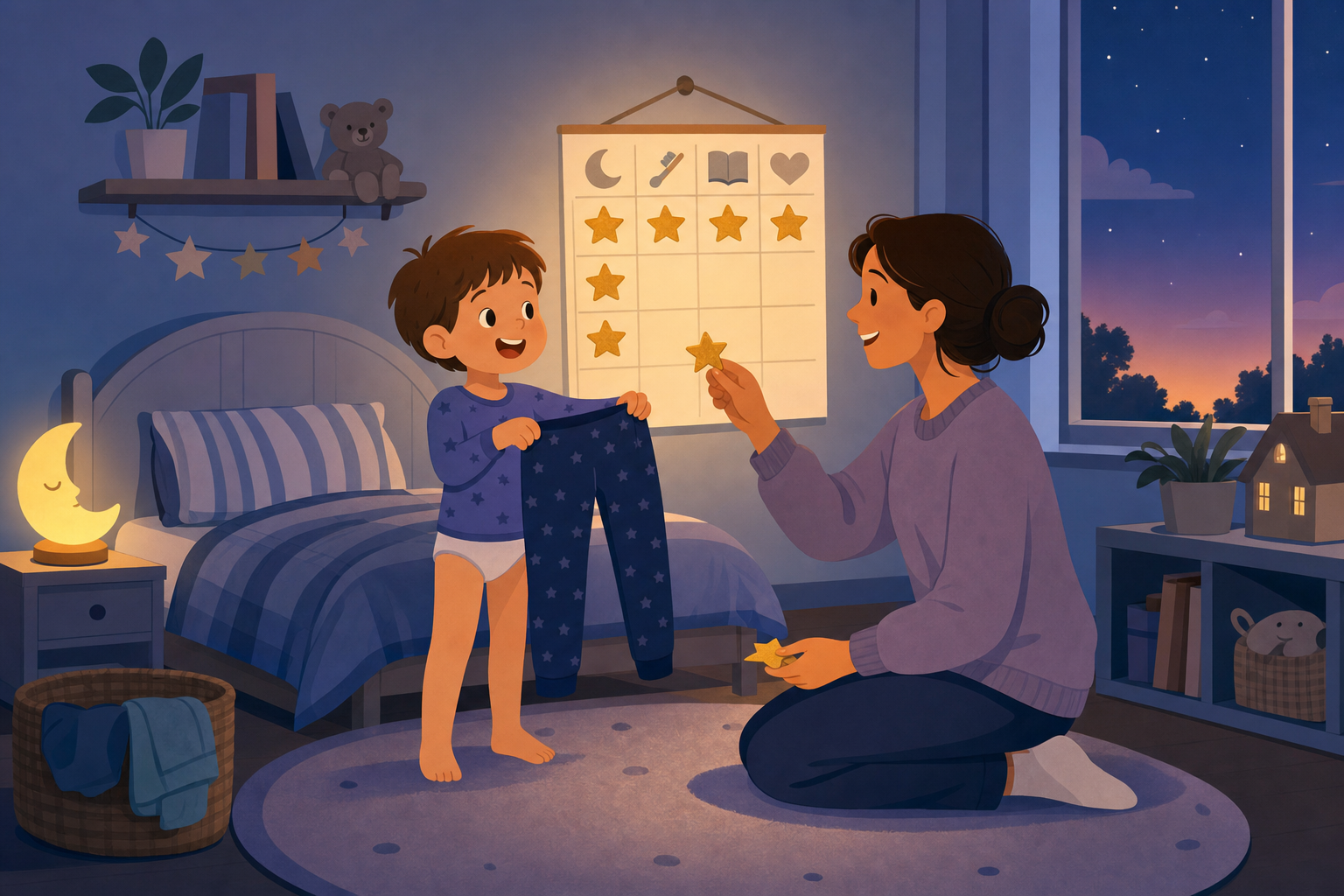
How to Use a Sticker Chart for a Kid Who Refuses Pajamas at Bedtime
You say "pajama time" and your 4-year-old bolts across the house like you announced a fire drill. Twenty minutes later you're holding a pair of dinosaur pajamas, negotiating like a hostage situation, and bedtime is already blown. If this happens most nights, a sticker chart aimed at that one exact moment (not the whole bedtime routine) can break the cycle faster than you'd think.
Most bedtime reward chart printables try to cover the entire routine: bath, pajamas, teeth, story, lights out. That's too much for a kid who's only fighting you on one step. The fix here is narrower and more useful: build a sticker chart for bedtime resistance that targets pajamas specifically, then expand once that's solid.
Why the Pajama Step Turns Into a Battle
For a lot of 3 to 6 year olds, pajamas aren't the actual problem. They're the signal that fun is ending. Putting on pajamas means the day is truly over, and that's a hard thing for a young kid to accept, especially if they're overtired or mid-hyperfocus on a toy.
Some kids also genuinely hate certain fabrics, tight cuffs, or footed styles. Before you build a chart, rule that out. Let them pick between two pajama options so texture isn't the hidden issue.
Once you've ruled out sensory stuff, you're left with a behavior pattern: pajamas equal transition, and transitions equal resistance. That's exactly what a visual bedtime chart for a 3 year old (or 4, 5, or 6 year old) is built to solve.
Building a Bedtime Behavior Chart for Toddlers That Targets Pajamas
Skip the elaborate 8-step chart for now. Start with a chart that has one job: get pajamas on without a fight, for one week.
Here's a simple setup:
- The goal: "I put on my pajamas when Mom/Dad asks (within 2 tries)."
- The reward: One sticker per night it happens, no sticker on nights it doesn't (no punishment either, just no sticker).
- The prize: Something small and immediate feels more motivating than a big prize far away. Five stickers in a row could mean picking the weekend breakfast, an extra bedtime story, or 10 minutes of one-on-one time with a parent.
You can build this in about two minutes with Sticker Chart Maker, print it, and stick it right next to the pajama drawer so it's part of the visual cue, not just a chart on the fridge nobody looks at.
If your child also fights other parts of bedtime, or fights getting started on tasks in general, it helps to look at how a visual routine chart handles morning transition overwhelm for kids who stall out at the start of a task. The same stalling pattern shows up at night, just with different clothes.
Making the Chart Actually Work (Not Just Look Nice on the Fridge)
A printable chart doesn't fix bedtime by itself. How you use it in the moment matters more than the chart design.
Give a warning before pajama time, not a surprise announcement. "Ten more minutes, then pajamas" works better than shutting off the TV and demanding pajamas cold.
Offer a choice inside the routine instead of a choice about whether it happens. "Do you want to put your shirt on first or your pants first?" beats "Will you please put your pajamas on?" The second one invites a no.
Let them do the sticker themselves. Handing your child the sticker and letting them place it on the chart gives them a tiny moment of control, which is often what the pajama refusal was actually about in the first place.
Keep the chart visible during the actual moment of resistance. If your child stalls, point at the chart instead of repeating yourself five times. "I see you're getting your pajamas on, that sticker's waiting for you" works better than a fourth reminder.
Don't chain it to threats. A sleep reward chart for kids should feel like a game, not a countdown to punishment. If you find yourself saying "no sticker AND no story," you've turned it into a consequence system, and that tends to backfire with this age group.
When the Sticker Chart Stops Working After a Few Days
Some nights the novelty wears off fast, especially with a strong-willed 5 or 6 year old. If stickers stop landing by day four or five, here's what to check first:
- Is the prize actually motivating? A sticker alone is rarely enough for a child who's already indifferent to stickers. Pair it with a real (small) reward at 5 or 7 stickers.
- Is bedtime itself too late? An overtired kid fights every step of bedtime harder, pajamas included. Moving bedtime 20 minutes earlier sometimes fixes more than any chart.
- Is the goal too big? If "put pajamas on" is still a fight, shrink it further: "pick out pajamas" gets its own sticker for a few nights before you add "put them on."
If the whole chart concept fizzles fast for your kid regardless of the reward, it might be worth trying a completely different visual system rather than more stickers. A flip-and-swap style routine chart keeps things fresh for kids who lose interest in the same static chart after a few days, and it works well for bedtime steps too.
A Small Reward for a Finished Chart
Once the pajama step is solid for a week or two, you can fold it back into a fuller bedtime behavior chart for toddlers that covers the whole routine, bath to lights out. At that point the end-of-week reward can get slightly bigger since it's covering more ground.
For the reward itself, keep it screen-free and low-cost. A free coloring page from Chunky Crayon makes a nice no-cost prize once the chart is full, something your child can pick out and print themselves as part of the celebration.
If sibling dynamics are part of the bedtime chaos too, like one kid stalling on purpose to get a rise out of a brother or sister, it's worth reading up on how a sticker chart for siblings who fight handles that kind of rivalry, since bedtime is prime time for that behavior to show up.
The Bottom Line
A bedtime reward chart printable works best when it's aimed at the exact moment your child resists, not the whole routine at once. For pajama refusal specifically, keep the goal small, let your child place their own sticker, and pick a reward that actually excites them. Once pajamas stop being a fight, you can expand the chart to cover the rest of bedtime with a lot less resistance than when you started.