August 20, 2026
Sticker Chart for Kids Who Won't Follow Directions
End power struggles with a listening reward chart for toddlers and preschoolers. Get your free printable reward chart for good behavior today.
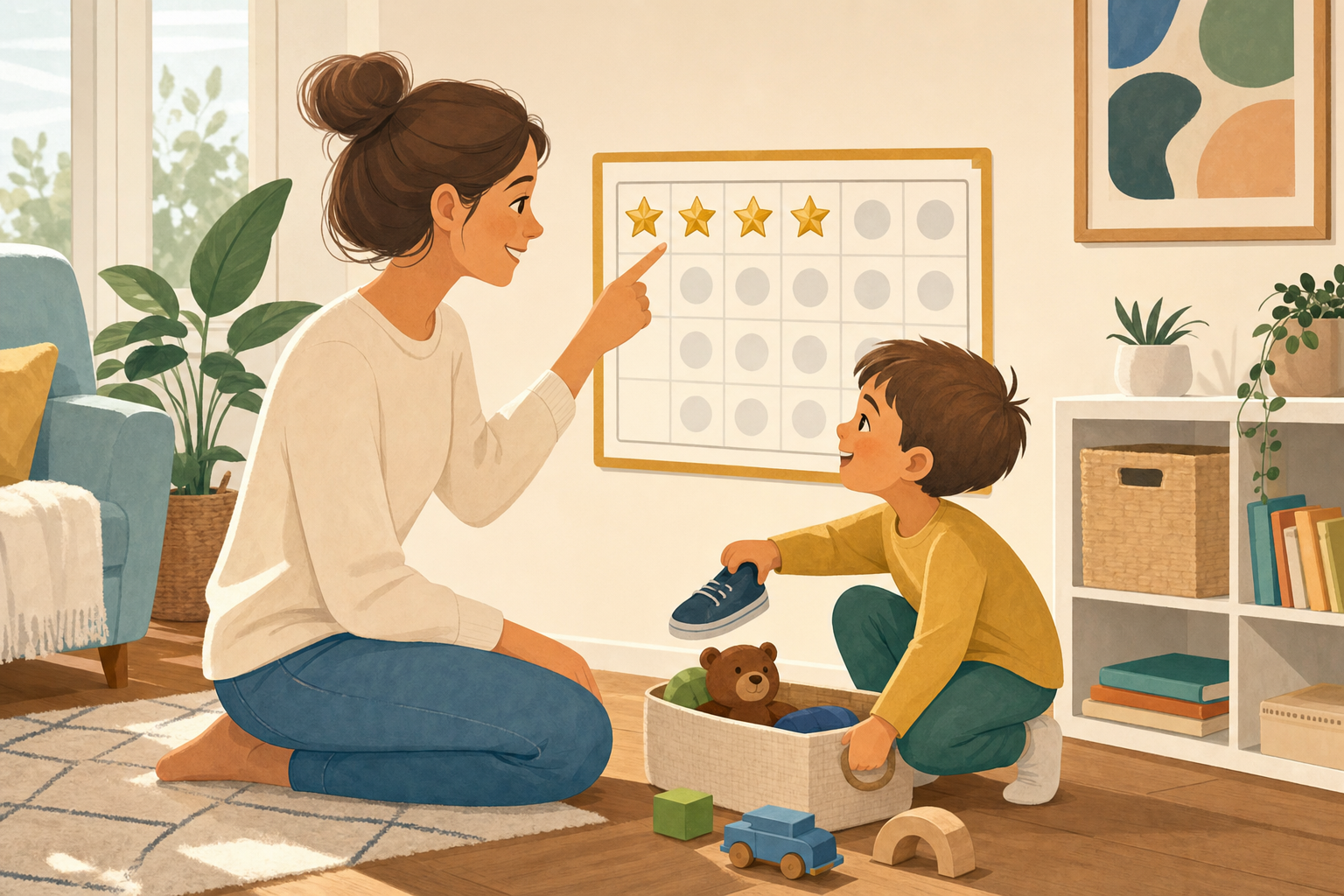
How to Use a Sticker Chart for a Kid Who Won't Listen the First Time
You ask once. You ask twice. By the third time you're using the voice, the one you swore you'd never use, and now everyone's upset over something as small as putting shoes on. If this is your daily loop with a 3- to 6-year-old, the problem usually isn't defiance. It's that "listening" has never been defined, tracked, or rewarded as its own skill. A sticker chart for a child who won't listen can fix that, but only if you set it up differently than a standard behavior chart.
Most printable reward charts for good behavior lump "listening" in with a dozen other things, like a vague line item next to "be kind" and "share toys." That's too fuzzy for a 4-year-old to act on. This post walks through a first time listening sticker chart built specifically to reduce the repeat-and-repeat cycle, without turning every request into a standoff.
Why Generic Behavior Charts Don't Fix the Listening Problem
A lot of behavior charts fail young kids because they reward the wrong moment. They give a sticker for "good behavior all day," which is too far away from the actual instruction for a 3- or 4-year-old brain to connect the two.
Here's what actually happens in the repeat-and-repeat pattern:
- You give an instruction once, casually, from another room.
- Nothing happens, so you repeat it, now with an edge in your voice.
- Your kid either ignores you again or waits for the third, sharper request before moving.
- Eventually they learn that the first two requests are optional. Only the loud one counts.
A sticker chart for following directions works by rewarding the moment right after the first ask, not the whole day. That's the piece most generic charts skip.
Set Up a Follow Directions Behavior Chart That Targets One Moment
Skip the multi-category chart for now. Build a chart with a single, narrow job: reward listening on the first ask, in specific situations you pick.
Start with two or three instructions your child already mostly knows how to do, just not on cue. Good starter choices:
- Coming to the table when called for meals
- Putting shoes on when you say it's time to go
- Stopping play and coming inside
Avoid starting with anything involving a strong preference battle, like turning off a screen or leaving a friend's house. Those need their own approach later once the first-time-listening habit is more established.
Label each row with the specific instruction in kid language: "Comes to eat when called" instead of "Listens well." Specific instructions are easier for a young child to picture and easier for you to judge fairly in the moment.
How to Explain "First Time" So It Doesn't Feel Like a Trap
The phrase "first time" can feel like a gotcha to a kid who's used to getting three chances. Introduce it calmly, outside of a moment of conflict, ideally at a relaxed time like after dinner or during a car ride.
Try something like: "Starting tomorrow, if you do the thing I ask right when I ask it, without me having to say it again, you get a sticker. If I have to ask twice, no sticker that time, but you can still try again next time."
A few things that make this land better:
- Define "first time" generously at first. A 10-second pause to finish a sentence or put down a toy still counts. You're building the habit, not running a drill sergeant operation.
- Use a visual or verbal cue before the instruction, like saying their name first, so you know they actually heard you. "Mia, shoes on please" is fairer to judge than a directive shouted from another room.
- Skip stickers for anything you had to physically help with, like walking them to the shoe bin. Save that for a smaller "trying" sticker if you want a middle category.
This approach pairs well with visual routines for kids who get stuck mid-task rather than ignoring you outright. If mornings are where most of the repeated requests happen, a visual morning bathroom routine chart can work alongside the listening chart so kids know what's next without you narrating every step.
Keep the Reward Small and the Feedback Immediate
The sticker itself matters less than the timing. For a 3- to 6-year-old, the gap between the behavior and the sticker needs to be minutes, not hours. Keep the chart somewhere visible and reachable, like on the fridge or a low wall in the kitchen, so the sticker goes on right after the moment happens.
A workable reward structure:
- 1 sticker per instance of first-time listening
- A small reward at 5 stickers (extra bedtime story, picking dinner side dish)
- A slightly bigger reward at 15 or 20 stickers (a trip to the park, choosing a family movie)
Keep the big reward genuinely small. The goal is building a habit, not running a prize economy. A free coloring page from Chunky Crayon makes a nice no-cost reward when the chart fills up, especially for kids who like having something to show for their effort right away.
When the Chart Stops Working (and What to Do Instead)
Be honest with yourself about this: a reward chart for a child who won't listen works on the mechanics of listening, not on why they're tuning you out in the first place. If the resistance is really about transitions, overstimulation, or one specific power struggle (like screen time), the chart will plateau.
Signs the chart needs an adjustment, not an increase in stickers:
- Your child seems anxious or is crying about the chart itself. Back off the pressure and shrink the ask.
- They're listening for the sticker but melting down the second it's gone (sticker fatigue). Rotate in a non-sticker reward, like a checkmark toward screen time or a token they trade in.
- The same one or two instructions never improve no matter what. That instruction might not be a listening issue. It might be a skill gap, a sensory issue, or simple overwhelm.
If siblings are part of the daily chaos, a shared incentive can sometimes work better than parallel individual charts. For families dealing with fighting on top of not listening, a sticker chart for siblings who fight tackles that overlap directly. And if toy cleanup is one of the specific instructions triggering the most pushback, there's a dedicated approach in the sticker chart for toy cleanup tantrums post that pairs well with this one.
A Realistic First Week
Don't expect a clean transformation by day three. A realistic first week looks like:
- Days 1 to 2: lots of reminders about the new system, maybe a few tears about "that's not fair"
- Days 3 to 4: first-time listening starts happening for the easier instructions
- Days 5 to 7: you're still repeating yourself for the harder instruction, and that's fine
Print a simple printable reward chart for good behavior focused only on first-time listening, pick your two or three target instructions, and give it a full two weeks before deciding if it's working. Most of the improvement comes from the predictability of the system, not the stickers themselves. The stickers just make the improvement visible to your kid, and to you, on a day when it doesn't feel like anything is working at all.