June 30, 2026
Potty Training Chart for Girls Afraid of the Toilet
Free printable potty training sticker chart for girls who are scared of flushing. Confidence-building rewards help toddlers overcome toilet fear step by step.
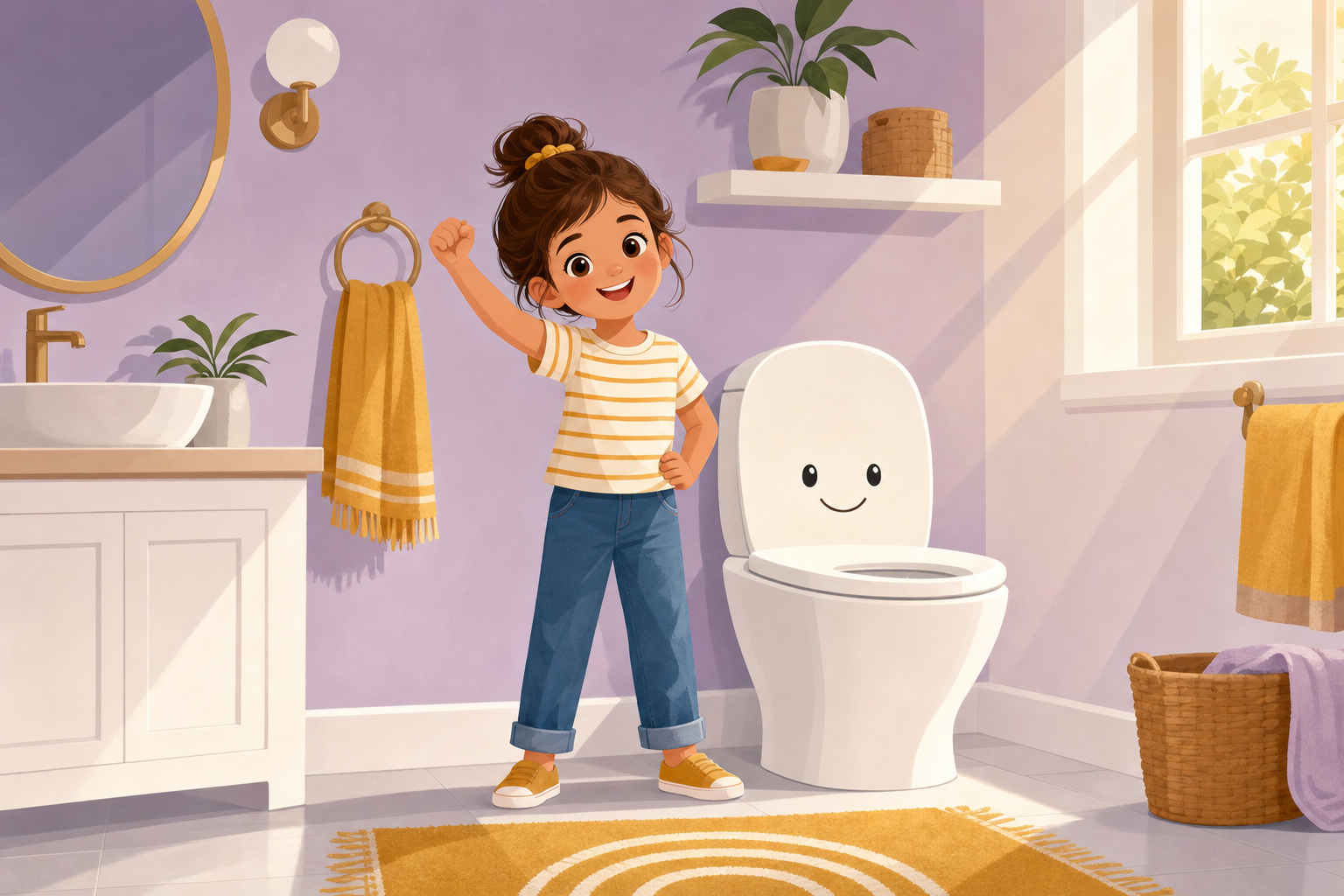
Potty Training Sticker Chart for Girls Who Are Scared of the Toilet
Your daughter is old enough, shows all the signs of readiness, and you've got the cute underwear picked out. But the second she sees the toilet, she's backing away like you asked her to pet a dragon. The flush sound makes her cover her ears. And the idea of sitting on that big white bowl? Not happening.
Fear of the toilet is one of the most common potty training roadblocks for girls aged 2-4, and it turns what should be a milestone into a daily power struggle. A generic sticker chart won't fix this because the problem isn't motivation. It's genuine anxiety. You need a reward system that builds confidence in tiny, manageable steps instead of expecting her to jump straight to using the toilet like it's no big deal.
Here's how to use a potty training sticker chart specifically designed for girls who are scared, plus the psychological strategies that actually reduce toilet fear instead of just bribing through it.
Why Fear of the Toilet Happens (and Why It's Normal)
Toddler girls often develop toilet fear around ages 2-3 because their imagination is developing faster than their logical thinking. The toilet is loud, echoey, and has a hole that things disappear into. From her perspective, it's reasonable to worry she might fall in or get sucked down.
The flush sound can genuinely hurt sensitive ears in a small bathroom. And if she's ever seen something she cared about (a toy, a piece of toilet paper she decorated) vanish down the drain, her brain has filed "toilet" under "things that take stuff away forever."
Punishment, pressure, or acting like her fear is silly will make it worse. She needs proof that the toilet is safe, and that proof has to come in steps so small she barely notices she's making progress.
How to Structure a Potty Training Sticker Chart for Scared Girls
A standard potty chart rewards the end goal: using the toilet. But when your daughter is scared, you need to reward the approach behaviors that lead up to sitting on the toilet. Break the process into 5-7 micro-steps and give a sticker for each one.
Here's a confidence-building sticker ladder that works:
- Step 1: Walk into the bathroom with you (no pressure to do anything)
- Step 2: Stand next to the toilet while you flush it (she can cover her ears)
- Step 3: Sit on the closed toilet lid with clothes on
- Step 4: Sit on the open toilet with clothes on
- Step 5: Sit on the toilet with pants down (diaper still on)
- Step 6: Sit on the toilet without a diaper (even if nothing happens)
- Step 7: Actually pee or poop in the toilet
She earns one sticker per step per day. If she only makes it to Step 2 today, that's fine. Tomorrow she might try Step 3. The chart shows her she's moving forward even on days when she doesn't actually use the toilet.
This approach is similar to the gradual confidence-building strategy in our potty training sticker chart for 4-year-old resistance guide, but tailored specifically for anxiety instead of defiance.
Fear-Reduction Rewards That Actually Help
The rewards you pick matter as much as the chart itself. Avoid anything that increases pressure ("If you use the toilet 5 times, we'll go to the toy store!"). That makes the toilet feel like a test she might fail.
Instead, choose small rewards that reinforce the idea that the bathroom is a calm, safe place:
- A special bathroom-only basket of tiny toys she can only touch after earning a sticker
- Picking a song to sing together while she sits (even if she doesn't go)
- One M&M or chocolate chip per sticker (immediate, low-stakes)
- A stamp on her hand with a fun design
- Adding a cotton ball to a jar (when it's full, pick a low-key outing like the park)
- A free coloring page from Chunky Crayon she can color while sitting on the toilet (clothes on, lid down at first)
The reward should feel like a natural part of the bathroom routine, not a bribe for performing. You're teaching her that the bathroom is where good things happen, not where she has to prove herself.
What to Do About Flush Fear Specifically
If the flush sound is the main issue, you can desensitize her in parallel with the sticker chart. Let her flush when you're done (standing far back if she wants). Let her drop toilet paper in and flush it while you hold her. Count down together before the flush so it's not a surprise.
Some parents have success with letting their daughter leave the bathroom before flushing at first. Yes, you'll be flushing for her for a few weeks. That's okay. Once she's comfortable sitting and going, the flush fear usually fades because she's built positive associations with the toilet itself.
You can add a separate sticker line on the chart just for flush exposure ("I stayed in the bathroom while Mom flushed"). This keeps it optional and low-pressure.
When the Chart Isn't Working: What to Adjust
If she's stuck on the same step for more than a week, the step is too big. Break it smaller. "Sit on the closed toilet" might need to become "touch the toilet seat with one hand" first.
If she's refusing to even walk into the bathroom, pause the chart and spend a few days just playing in there with the door open. Bring toys. Read books while you sit on the closed toilet and she plays on the bath mat. Make it boring and normal before you reintroduce the chart.
If she's scared of a specific toilet (often the loud public ones or a basement bathroom), don't force it. Master the main home bathroom first. You can add a bonus sticker later for trying a different toilet once she's confident.
Some girls respond better to a "build-a-picture" chart instead of rows of stickers. Every small step adds one piece to a puzzle or one part of a picture (a flower gets petals, a castle gets towers). The visual progress feels less like a test.
How Long This Actually Takes
With a fear-based approach, expect 3-6 weeks of daily chart use before she's reliably using the toilet. That's longer than the "3-day method" you see online, but those methods don't account for genuine anxiety.
You're not just teaching a skill. You're rewiring her emotional response to a thing that scares her. That takes time, repetition, and a lot of calm, no-pressure exposure.
Most parents see a breakthrough around week 3, where she suddenly wants to try the next step without prompting. That's when the stickers shift from "convincing her" to "celebrating what she's already ready to do."
If you're also working on other routines like hand washing after outdoor play, the same gradual approach helps (our hand washing sticker chart guide breaks down the step-by-step method for another common bathroom resistance issue).
The Printable Chart Setup That Works Best
Use a chart with 7 columns (one per step) and 7-10 rows (one per day). Tape it to the bathroom wall at her eye level so she can see her progress while sitting on the toilet.
Let her pick the stickers. Puffy ones, glittery ones, character ones, it doesn't matter. The act of choosing and placing the sticker is part of the reward.
Don't make her ask for the sticker. As soon as she completes a step, even if it's just walking into the bathroom, hand her the sheet and let her stick it on. The immediacy matters more than the prize at the end.
Some parents add a photo of their daughter next to the chart with a speech bubble that says "I'm brave!" or "I'm learning!" This reinforces that the chart is about her growth, not about making you happy.
What to Say (and Not Say) While Using the Chart
Avoid: "See, that wasn't so scary!" (invalidates her feelings) or "You're such a big girl now!" (adds pressure to keep performing).
Try: "You walked all the way to the toilet. That took courage. Here's your sticker." Or: "I noticed you sat for five whole seconds today. Yesterday it was three. You're getting more comfortable."
Narrate her progress without judgment. The chart is a tool for her to see her own growth, not a report card for you to grade.
If she regresses (common after illness, travel, or a new sibling), just move back a step or two on the chart without comment. You're not starting over. You're just meeting her where she is today.
Print Your Fear-Reduction Potty Chart
Head to Sticker Chart Maker and build a custom chart with 7 steps and whatever theme makes your daughter smile (unicorns, butterflies, and rainbows are popular for girls, but some prefer dinosaurs or trucks, and that's perfect too). Print a fresh one each week so she can see the full arc of her progress.
The tool is free, no signup required, and you can print as many copies as you need when she's ready to add new steps or start over after a setback.
Potty training a scared child isn't about finding the right bribe. It's about building trust in tiny increments until the toilet stops being a threat and starts being just another part of her day. The stickers are just proof that she's braver than she thought.